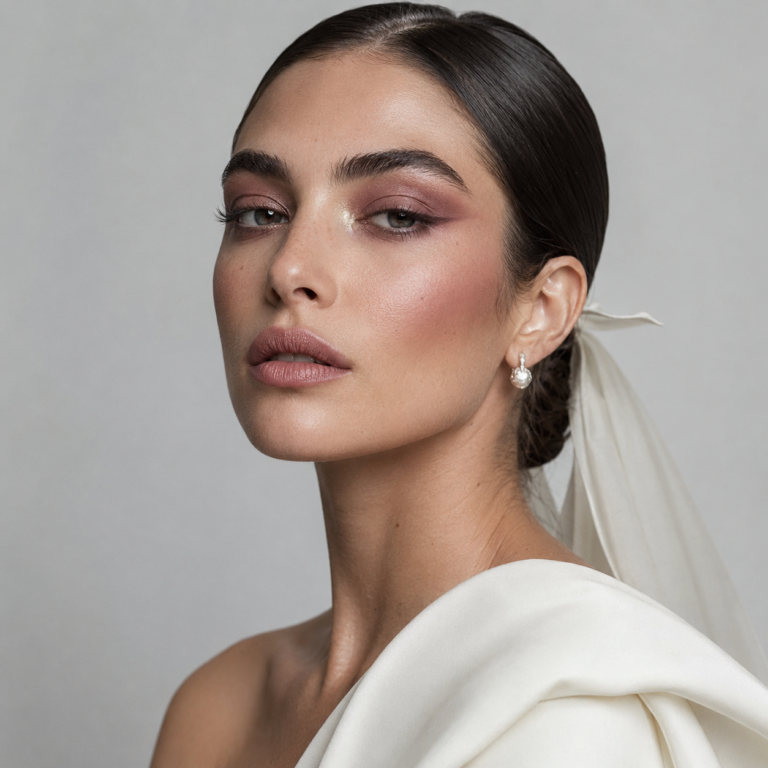
Have you ever looked in the mirror and felt that your makeup was perfectly defined, only to see a photograph where the colors appeared softer and some of the definition seemed to disappear? Or perhaps the opposite happened: the makeup looked subtle in person but appeared stronger under flash photography.
Makeup does not look exactly the same to the human eye as it does through a camera. Lighting, lenses, flash, image processing, distance, and screen settings can all change the way we perceive color, texture, contrast, and facial dimension.
This is why professional makeup is not created only for the mirror. A makeup artist must consider how the look will appear in real life, under the lighting of the event, and in photographs and video.
The goal is to find the right balance—makeup that looks polished and refined in person while remaining visible, dimensional, and flattering on camera.
The Camera Sees the Face Differently
The human eye observes a face continuously and from multiple angles. We see movement, expression, natural changes in light, and the relationship between all facial features.
A photograph captures only one moment, from one position, under one set of lighting conditions. It transforms a three-dimensional face into a two-dimensional image.
During this process, some of the face’s natural depth can be reduced. Cheekbones may appear less defined, eyes can look smaller, and subtle colors may lose intensity. Features that are beautifully visible in person may look softer or flatter in a photograph.
Professional makeup helps return that dimension through carefully placed color, light, shadow, and definition.
This does not mean that the face needs heavy contouring or excessive product. It means that the makeup artist must understand how much definition is required for both the person and the camera.
Lighting Changes Everything
Makeup can look very different depending on the light surrounding it.
Natural daylight usually reveals the most accurate version of color and texture. Warm indoor lighting may make the complexion appear more golden or soften certain shades. Cool lighting can emphasize redness or make the skin look paler. Dim evening lighting may reduce the visibility of blush, eye definition, and subtle contouring.
Direct flash creates another effect. It produces strong, immediate light that can flatten the face, emphasize shine, or reflect from certain areas and products.
This is why the same makeup may appear fresh and balanced in daylight, softer in a dark venue, and more contrasted in a flash photograph.
Before creating a professional makeup look, an experienced artist considers where the client is going and how the space will be lit. Makeup for an outdoor daytime event may require a different balance from makeup created for an evening gala, stage appearance, or studio photoshoot.
Photography Can Reduce Color and Definition
Cameras often soften the visual intensity of makeup, especially when the photograph is taken from a distance or under bright lighting.
A blush that appears perfectly noticeable in the mirror may almost disappear in a photograph. Subtle eyeshadow transitions can become less visible, and a softly defined lip may blend into the rest of the complexion.
For this reason, professional makeup sometimes appears slightly more defined in person than a client is accustomed to seeing in her everyday routine.
The artist may add a little more blush, strengthen the lash line, refine the brows, or create slightly more dimension in the face so that the look remains balanced on camera.
This does not mean making every feature stronger. It means knowing where additional definition is necessary and where the makeup should remain soft.
More Makeup Is Not Always Better for Photography
There is a common belief that makeup for photographs must always be heavier. That is not necessarily true.
Modern cameras, particularly high-resolution professional cameras, can reveal very fine details in the skin. Excessive foundation, concealer, or powder may become more noticeable in close-up photographs than it appears from a normal conversational distance.
Texture is also a natural part of real skin. Makeup can even out color and create a more polished finish, but it cannot—and should not—make the skin look completely artificial.
The best camera-ready makeup is not simply heavier makeup. It is more intentional makeup.
Products are selected carefully, coverage is built only where it is needed, and texture is controlled without removing all natural life from the skin. The result should remain polished when viewed closely while still having enough definition for wider photographs.
Complexion Products Behave Differently Under Flash
Foundation, concealer, powder, and skincare products can react differently when exposed to strong flash.
Some highly reflective ingredients, certain mineral-based products, or an excessive amount of particular setting powders may create a pale or overly bright appearance in photographs. This effect is often called flashback.
SPF itself should not automatically be considered a problem, and sun protection should not be skipped without considering the time and setting of the event. However, complexion and skincare products should be selected thoughtfully when strong professional flash photography is expected.
An experienced makeup artist considers how formulas perform together, how much powder is necessary, and where reflective products should be placed.
The complexion should look balanced—not flat, overly matte, greasy, or unnaturally bright when photographed.
Shine and Glow Are Not the Same
Healthy, luminous skin is one of the most requested makeup finishes, but creating glow for photography requires control.
Glow is placed intentionally to bring freshness and dimension to the face. Uncontrolled shine can reflect light from areas where it is not flattering and may make the complexion appear oily in photographs.
A professional makeup artist may keep the high points of the face luminous while softly setting areas such as the center of the forehead, sides of the nose, around the mouth, and other places where excess shine tends to appear.
The exact placement depends on the client’s features and skin condition.
The objective is not to make the entire face matte. It is to preserve natural radiance while controlling the way light reflects from the skin.
Facial Features Need Thoughtful Definition
Brows, lashes, lips, blush, and facial structure can all lose some of their impact through the camera.
Professional makeup restores balance without making every element equally strong. If the eyes are the main focus, the lips and complexion may remain softer. A bold lip may be balanced with more restrained eye makeup. Strong cheekbones may require only subtle enhancement, while another face may benefit from carefully placed sculpting.
The artist also considers the shape of the eyes, brows, lips, and face rather than following a standard photography formula.
Camera-ready makeup should still look like the person wearing it. Definition is used to support the individual face—not replace it.
Phone Cameras Add Their Own Interpretation
Professional cameras are not the only devices that change how makeup appears.
Smartphone cameras automatically process images by adjusting brightness, contrast, color, sharpness, and skin tone. Portrait modes can blur parts of the image, while beauty settings and social media filters may alter texture and facial proportions.
The front and back cameras of the same phone can also produce noticeably different results. The type of lens, distance from the face, and angle of the camera can affect how features appear.
This is one reason makeup may look different in a mirror, a selfie, a phone photograph taken by another person, and a professional image.
No makeup application can control every device or automatic camera setting. However, professional technique creates a balanced starting point that translates well across different forms of photography.
Makeup Should Be Checked From Different Perspectives
During a professional makeup appointment, the look should not be evaluated only through a magnifying mirror or from very close range.
A makeup artist steps back to see the balance of the entire face. The makeup may also be checked under different lighting or photographed to observe how the colors and definition translate through the camera.
This is especially valuable for:
- Bridal makeup
- Professional headshots
- Editorial and beauty photoshoots
- Red carpet and formal events
- Video and television appearances
- Stage makeup
- Events with professional photography
A photograph can reveal whether the face needs slightly more color, whether one feature appears stronger than another, or whether a reflective area should be adjusted.
Bridal Makeup Must Work in Many Environments
Bridal makeup is a particularly good example of why this balance matters.
A bride may be photographed in natural daylight, inside a ceremony venue, under warm reception lighting, with professional flash, on video, and through dozens of phone cameras—all on the same day.
Her makeup must look beautiful while she is speaking with guests from a close distance, but it must also remain defined in full-length photographs and group portraits.
This does not mean that bridal makeup must be dramatic. A soft bridal look can photograph beautifully when the complexion, blush, eyes, brows, and lips are balanced with photography in mind.
The level of intensity should always be adapted to the bride’s preferences, features, styling, and comfort.
The Best Professional Makeup Creates Balance
The most successful professional makeup does not exist only for photographs, and it is not created only for the mirror. It has to function in both worlds.
In real life, the skin should look refined rather than covered. The colors should feel harmonious, and the makeup should move naturally with the client’s expressions. In photographs, the face should retain its dimension, color, and definition without appearing heavy or artificial.
Achieving this balance requires an understanding of skin, facial structure, lighting, photography, products, and technique.
At Face Style Studio, every makeup look is customized not only for the client’s features and personal style, but also for the environment in which the makeup will be seen and photographed.
Whether you are preparing for a wedding, special event, professional photoshoot, or an important evening, your makeup should look beautiful from every perspective.